Koh Samui: Where to Live?
The best areas for nomads. Vibes, infrastructure, nature, activities, and beaches.
Where to Live on Koh Samui?
It’s a pretty common question, so let’s get straight to it. If you need infrastructure, social connections, and nightlife, the Northeast, around Chaweng or Bang Rak, is your best bet. If you prefer nature and tranquility, head Southeast, to the Lamai area.
Let’s take a look at the main districts, and I’ll share my impressions and tips for each.
Lamai
The southern part of the island is much more scenic and exotic than the north. You’ll find more wildlife (animals and birds), denser forests, waterfalls, viewpoints, and less road noise here. Lamai is the most convenient spot right on the edge of all this natural beauty. Life in Lamai feels a bit stuck in the past; it has a distinct village vibe, like stepping into an 80s movie. And that’s exactly what I love about Lamai.
Infrastructure
Lamai has all the essentials for long-term living and working. There are decent cafes, a beach, shops, markets, a small shopping center (Tesco Lotus), and bars with pool tables. During the day, trucks cruise the main street, blasting Eye of the Tiger at full volume to advertise upcoming Muay Thai fights. In the evening, neon signs light up the street, music spills out from bars and restaurants, and the air smells like BBQ and grilled fish. The ‘nightlife’ here is more like ‘evening life’. Things shut down relatively early, but you’ll find plenty of laid-back, village-style options open until around midnight.
Lamai Street
For your first few days or weeks, staying on Had Lamai Road (Lamai Street) – the main beach road – is a good option. There are plenty of hotels and guesthouses, it’s easy to get your bearings, and you can manage without a scooter initially. You’ll find breakfast cafes, dinner restaurants, and pool bars. There are evening food markets, a couple of spots with live music, tons of massage parlors, and even a quirky open-air bar complex featuring a Muay Thai ring. And, of course, the beach.
The Beach
Lamai Beach itself is decent; it’s the second most popular on the island after Chaweng. It feels a bit wilder and isn’t cleaned quite as meticulously. During the high season (roughly Dec-Mar), it’s usually fine, but in the summer and fall (low/shoulder season), the sea can wash up seaweed, debris, and sometimes jellyfish or other critters.
Long-Term Stay
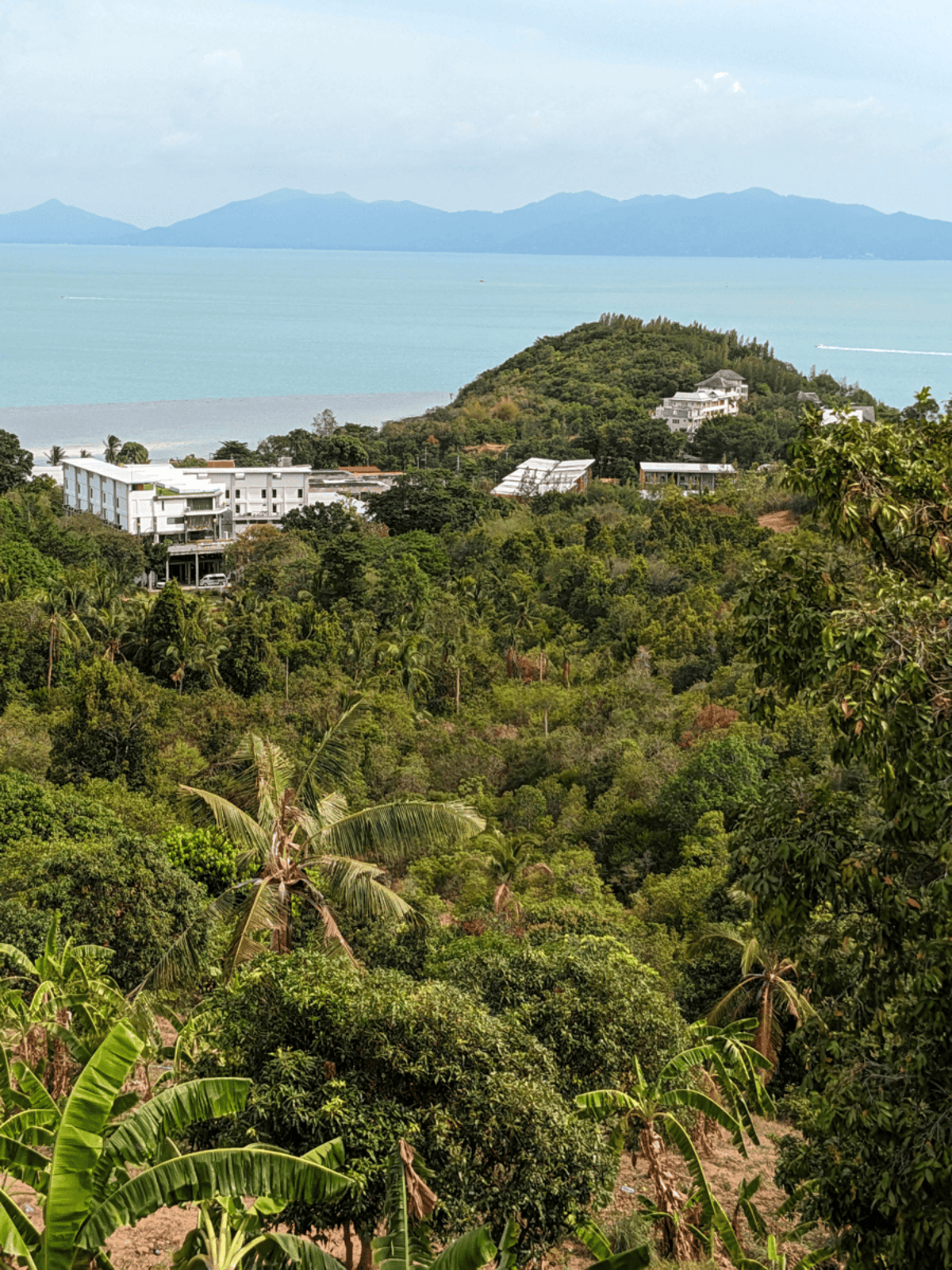
For a long-term stay, the best bet is to look for a house bordering the forest/hills inland from the ring road (the general area marked by the green dotted line on the map below, though the specific marker shows the beach). If you’re lucky enough to find a place on a hill, you’ll get stunning sea or jungle views.
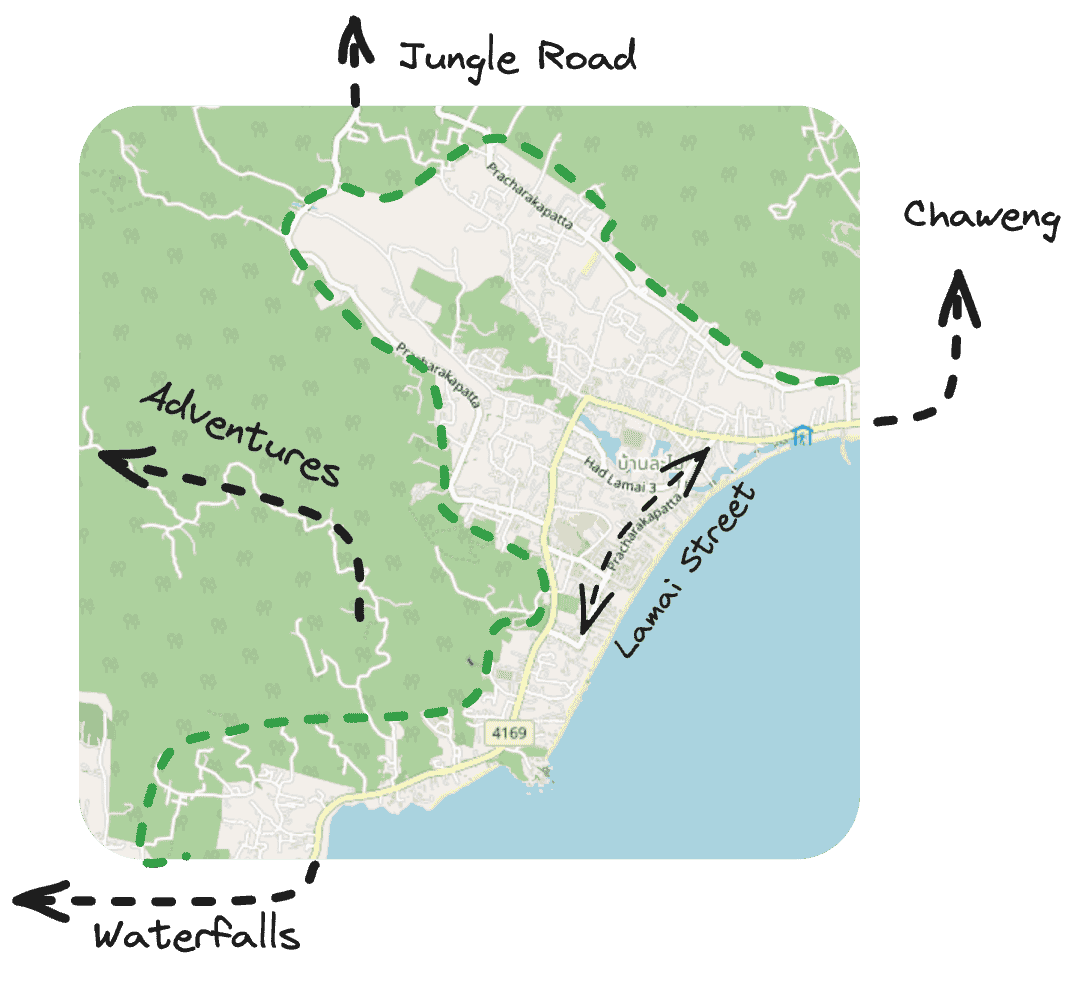
I personally love living close to nature; it enhances your day even if you’re working hard and don’t go out much. Birds sing in the forest, there’s lots of greenery, and no road noise. It’s lovely just to step outside for a walk.
Roads & Riding
Riding along the scenic roads is one of my favorite things to do on Samui. In my opinion, the most beautiful routes are around Lamai and in the central, mountainous part of the island. Wherever you ride, you’re surrounded by green hills, rock formations, palm trees, and the sea.
Key tip: try to live away from the main ring road (Route 4169), especially if your house is elevated, otherwise, it can be noisy from traffic.
Social Scene
Besides Muay Thai camps and bars, there aren’t many organized events or active communities in Lamai. Not much really happens here, which can be a pro or a con depending on what you’re looking for.
The Northeast
Bang Rak & Airport Area
The immediate area around the airport can be a bit rough and visually cluttered in parts – typical undeveloped side streets. The landscape here is flatter, and beautiful views are mostly found from elevated positions or right on the water. However, the coastline itself is very picturesque, dotted with luxury hotels, villas, and many decent resorts and long-term rental houses.
This area is popular with expats and snowbirds; it’s relatively close to key infrastructure (airport, Chaweng, Fisherman’s Village), quiet (away from the main tourist throngs), and has good restaurants and cafes. However, finding a house with a good view will be more expensive and harder to come by.
Bang Rak beach is more functional – it has piers and boats – but strolling along it or sitting in a seaside cafe is lovely. The piers in Bang Rak offer convenient ferry/speedboat access to Koh Phangan (around 30 mins) and Koh Tao.
You’ll also notice significantly more Russian-speaking tourists and expats here compared to Lamai. It’s not uncommon to walk into a cafe and find many customers speaking Russian.
Chaweng
Chaweng is all about nightlife, restaurants, and social hubs. It has the most comprehensive infrastructure, and it’s where the main action is. Expect hustle and bustle, traffic jams, tourists, shops galore, and countless hotels.
The Chaweng area hosts the large Central Samui mall – where you can find major brands, electronics, bank branches, mobile operators, a cinema, etc. It’s kind of the island’s main commercial center. Near the mall, you’ll find events, a walking street/lake area, night markets, and food courts.
Chaweng Beach is the island’s main swimming beach. It boasts fine white sand, (usually) clear waters, beach clubs, bars, and restaurants lining the shore. Most other beaches in the north are either functional (with piers/boats) or very shallow.
I doubt you can find decent long-term housing right near the main beach drag here. It’s primarily a tourist hub, dominated by hotels, and it’s noisy and crowded. However, being close to this area (perhaps living inland a bit) is a big plus for evening entertainment and socializing. Just like in Lamai, the nicest and most pleasant houses are usually located closer to the inland hills, inside the ring road, away from the beach chaos.
Fisherman’s Village (Bophut)
Pricey and upscale. Fancy restaurants, boutique shops, high-end hotels. Overall, it’s a nice, well-maintained area, but the establishments cater primarily to affluent short-term tourists rather than expats or long-stayers. There are a couple of decent cafes, a very popular walking street/night market (Fridays are huge), live music in the evenings, and generally a pleasant, slightly more sophisticated atmosphere. It’s a great spot to spend an evening, especially if you have friends visiting. But overall, it feels more like a place for a special occasion, not an everyday haunt.
Proximity to this area significantly bumps up rental prices. However, the beach itself isn’t great for swimming; the water is very shallow in this part of the island (Bophut bay).
The North Coast
The north coast is generally quieter and more laid-back than the Northeast, but it has its advantages. I’d say consider the north if you arrive during peak season and can’t find anything suitable between Bang Rak and Lamai, or if you prioritize quiet beachfront living. There isn’t much socializing or organized activity here, but you get nature, tranquility, quiet beaches, and decent housing options, often at better prices.
Maenam
Maenam has fewer ‘cool’ or trendy spots than Fisherman’s Village; the establishments and life lean more towards the ‘local Thai style’ and old-school backpacker vibe. However, you can find good houses near the inland hills in quiet, pleasant areas. The long beach is more for walking and relaxing, as it’s also quite shallow in many parts, but generally swimmable. For a wider variety of restaurants and cafes, you might need to drive 10-15 minutes towards Bophut or Bang Por. So, I’d call it a compromise – the area itself is a bit sleepy but pleasant and potentially good value. There’s a small walking street market on Thursdays.
Bang Por
Bang Por is a quiet and pleasant area whose main advantage is the possibility of renting a decent house with a kitchen right by the sea at a good price. The area is popular with families with young children due to the shallow water near the shore and pleasant beach (lots of palm tree shade). It’s uncrowded, with a relaxed pace of life and an authentic Thai atmosphere. Plus, you get stunning sunsets with views towards Koh Phangan (you don’t see the sun dip below the horizon itself from here, but the sky colors are beautiful).
The beach boasts clear water almost year-round, but further out (starting maybe 10-20 meters offshore depending on the spot) there can be corals and rocks, so water shoes might be useful if you explore further. During low tide season (roughly April-August), the sea retreats quite far, making swimming difficult right off the beach. People say you can snorkel right off the beach in some spots – exploring corals and marine life. I can’t personally vouch for it, though – haven’t tried it myself.
Infrastructure is minimal: a few local restaurants (some excellent seafood places right on the sand), a couple of small shops, and one 7-Eleven. For major shopping or entertainment, you’ll need to drive to Nathon (10 mins west), Maenam (10 mins east) or Chaweng (25-30 mins). Having your own transport is essential here, otherwise, it’ll feel inconvenient and isolated.
West and South Coasts
The southwest is predominantly where local Thais live. It offers the best direct sunsets and many wild, secluded spots, but there’s very little infrastructure for a typical nomad lifestyle. Let’s quickly run through the main locations here, mostly just to round out your picture of the island.
Nathon
Nathon is the island’s administrative center, housing the main government offices, police station, main post office, etc. The town itself isn’t particularly attractive, and tourist infrastructure (apart from some cafes and local shops) is almost non-existent. For visitors, it’s primarily an entry/exit point, as the main car ferries from the mainland dock here. But there’s no real reason to stay here; it’s not geared towards visitors seeking a beach holiday vibe. Good spot for authentic, cheap local food.
Lipa Noi
The Lipa Noi area has another ferry pier (Raja Ferry) and a long, quiet beach; it’s quite shallow for swimming in most parts. The shore itself is pleasant, with chill vibes, great sunsets, no crowds, and evening tranquility. However, there’s not much interesting infrastructure – mostly scattered resorts, private villas, and beach bungalows. The area feels a bit undeveloped and off-the-beaten-path. If you value seclusion and sunsets above all else, it could be an option, but lacks convenience.
Taling Ngam
It’s fun to ride around here sometimes – the roads are mostly empty, winding through coconut groves and hills, surrounded by greenery, with lots to explore off the main track. If you want to escape somewhere truly quiet and rural, the deep southwest (Taling Ngam) is the place. It’s proper rural Samui, with practically nothing around except for a few high-end resorts (like the Conrad or InterContinental perched on cliffs) and local Thai houses. Living here isn’t really a viable option for most nomads due to the isolation and lack of amenities.
Na Mueang (South Coast)
In the Na Mueang area (covering the central south) - aside from palm forests, the famous Na Muang Waterfalls, and the cool Laem Sor Pagoda right on the southern tip - there’s not much infrastructure for visitors. The coastline is rocky or undeveloped in many parts. Definitely worth a ride through the area to see the waterfalls and pagoda, but I wouldn’t recommend basing yourself here long-term.
Conclusion
Koh Samui is diverse and multifaceted; first impressions can be misleading, especially if you pick an area that doesn’t suit your needs or preferences.
Furthermore, finding good long-term housing can be tricky: not everything (in fact, maybe not even most things) is listed on Booking.com or Airbnb. Like many places in Thailand, many of the best options, especially houses, are found through local Facebook groups (search for “Samui rent house” etc.) or simply by looking around in person once you arrive and spotting “For Rent” signs.
Ideally, if you have the time, I’d recommend trying out a couple of different areas (maybe a week or two in each) to get a feel for their unique vibes before committing to a longer stay.
I feel like Samui doesn’t necessarily reveal all its charms immediately. It’s not particularly outstanding in terms of major, must-see tourist attractions compared to places like Chiang Mai or Bangkok. Its real value, I believe, lies in immersing yourself in the relaxed local pace of life: slowing down, exploring different beaches and viewpoints on your scooter, finding hidden cafes, enjoying the lush nature, and adapting to the island rhythm.
MORE